

How to Build a Concrete Outdoor Shower for Your Backyard
March 25, 2026
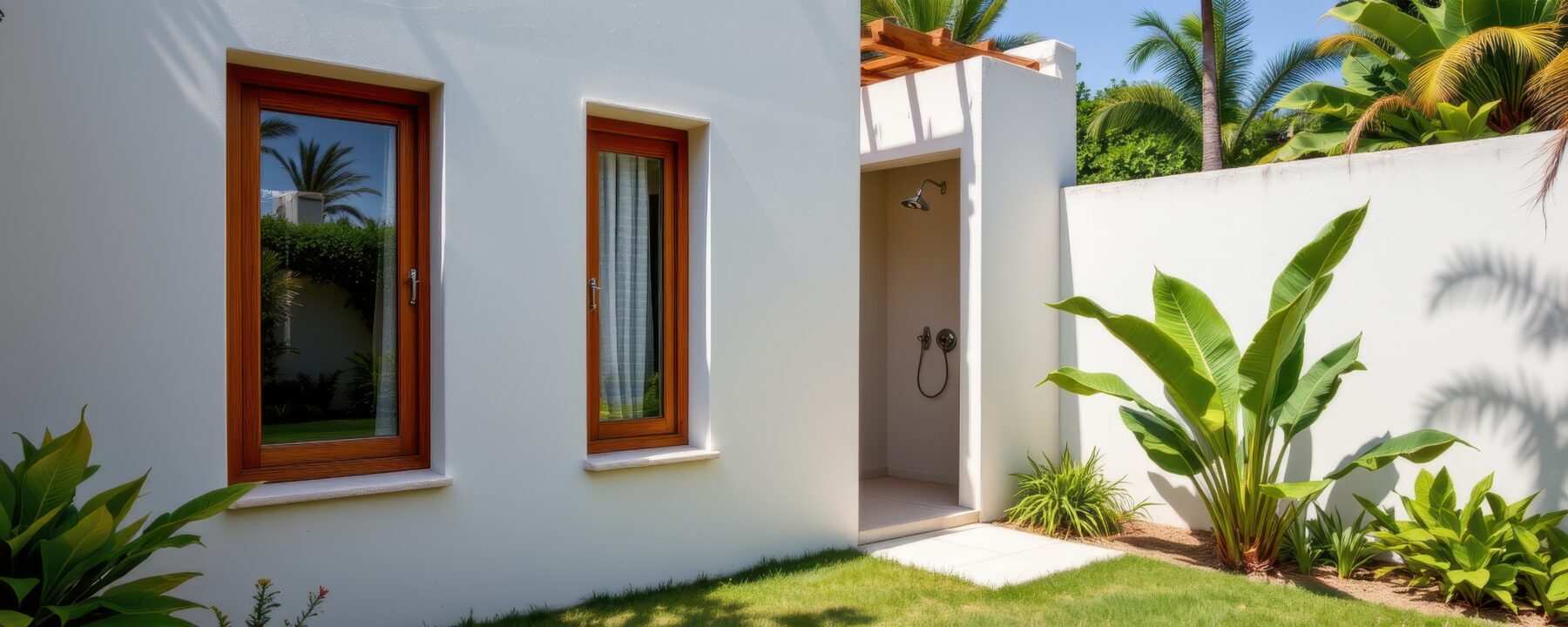
Ground conditions and daily water exposure create unique challenges for building an outdoor shower. The slab needs to manage moisture flow, adapt to seasonal temperature changes, and handle subtle soil movement beneath it. Concrete is an ideal material because it provides mass, drainage control, and surface stability in a durable structure. By following a step-by-step process, from sub-base preparation to curing, the finished shower will maintain its strength and appearance through repeated use.
Preparing the Sub-Base and Slab
Compacted aggregate establishes the base condition that determines how the slab behaves. Excavation should allow room for a four to six inch layer of angular aggregate, adjusted to soil type and expected load. Placing the stone in lifts and mechanically compacting each layer increases particle interlock and reduces void space that can translate into settlement cracking.
Slope must be formed before placement begins. A quarter inch per foot pitch toward a drain moves water consistently across the surface instead of allowing it to pool. Forms must reflect that pitch precisely, since fresh concrete follows the boundaries established during setup. Reinforcement positioned in the upper third of the slab thickness restrains shrinkage stress as hydration progresses. Proper consolidation during placement removes trapped air and increases internal density, creating a slab that responds predictably under daily water exposure.
Forming and Pouring Vertical Walls
Fresh concrete generates lateral pressure against wall forms. Bracing must counter that force to maintain straight planes and clean corners during the pour. Even minor movement in formwork can leave surface irregularities that require corrective grinding later.
Placing concrete in controlled lifts limits cold joints and uneven bonding between layers. Mechanical vibration during placement reduces voids along form faces and around reinforcement, tightening the surface structure. Walls consolidated correctly develop a denser exterior layer that resists moisture intrusion. Curing compound or damp coverings slow surface evaporation, sustaining hydration and limiting shrinkage cracking during early strength development.
Creating a Safe and Functional Finish
Running water changes how the surface must perform under bare feet. A broom finish introduced after bleed water dissipates creates fine ridges that increase traction without discomfort. Timing is critical, since finishing too early weakens the surface and finishing too late prevents proper texture formation.
Wall surfaces may remain as-cast for a clean architectural profile or receive a light trowel pass for a smoother feel. Breathable sealers reduce absorption of soap residue and mineral deposits while still permitting vapor transmission through the slab. Control joints cut at appropriate spacing guide shrinkage into defined lines. Proper joint depth encourages cracks to form within those planes instead of across the visible surface.
Coordinating Plumbing and Structural Elements
Embedded sleeves placed before pouring create protected channels for supply and drainage lines. Casting these penetrations during placement preserves reinforcement layout and slab integrity. Anchors set into fresh concrete establish secure attachment points for fixtures without post-installation drilling.
Sealants applied at penetrations block water migration into surrounding surfaces. Drainage components tied directly into the pitched slab move water efficiently away from the enclosure. Soil graded away from the perimeter keeps runoff from saturating the base layer beneath the slab. As hydration continues in the days following placement, protecting the surface from heavy impact and maintaining proper drainage preserves internal structure and surface stability.
A concrete outdoor shower performs as a unified system when aggregate compaction, mix placement, finishing, and curing are executed with precision. Each phase directly shapes how the slab and walls respond to water exposure and seasonal movement. Coordinated properly, the result is a structurally grounded installation that maintains its profile and surface integrity through repeated use.